
Every great teacher can trace their journey back to one decision: where they chose to train. Teaching is not a profession you simply qualify for — it is a craft you are shaped into, over months of lesson planning, classroom practice, feedback, and mentorship. That shaping happens at your B.Ed college, which is why the search for the B.Ed College near Meerut and the surrounding western Uttar Pradesh–NCR belt is, for thousands of students every year, the single most important academic decision of their career.
If you are a Class 12 graduate exploring long-term career paths, a working graduate considering a shift into education, or a parent helping your child evaluate colleges, this guide is designed to walk you through everything that matters — from what a B.Ed degree actually teaches you, to the exact benchmarks you should use while shortlisting colleges near Meerut, Hapur, and the greater NCR region. Along the way, we’ll look at what ATMS Group of Institutions offers, based strictly on information available on its official website (atms.ac.in), as a real-world reference point for what a strong teacher education program should look like.
By the end of this article, you’ll have a clear, practical framework for choosing where to begin — or restart — your professional teaching journey.
Why the Choice of B.Ed College Shapes Your Entire Teaching Career
It’s tempting to think of a B.Ed degree as just another two-year qualification. In reality, it is the single training ground where you develop the habits, confidence, and classroom instincts you will carry for the next thirty or forty years of your professional life.
Here’s why the college you choose matters so much:
- It determines the quality of your practical exposure. Two colleges can teach the same syllabus, but only one might send you into real classrooms for structured teaching practice.
- It shapes your mentorship experience. Faculty who have themselves taught in schools bring insights no textbook can replicate.
- It affects your eligibility and credibility. An NCTE Approved College with proper university affiliation protects the validity of your degree for competitive exams like CTET and UPTET.
- It influences your placement outcomes. Colleges with structured placement support open doors that self-directed job hunting often cannot.
- It builds your professional network. Alumni, faculty, and peer relationships formed during your B.Ed years often become lifelong professional resources.
In short, choosing the B.Ed College near Meerut and its neighboring districts isn’t about convenience alone — it’s about setting the trajectory of your entire Teaching Career.
What It Really Prepares You For
A Bachelor of Education (B.Ed) is a professional Education Degree designed to prepare graduates for teaching roles in schools, typically at the primary and secondary levels. Unlike a general academic degree, a B.Ed combines theory with hands-on Classroom Training, making it one of the more practically oriented postgraduate-entry programs in India.
H3: Core Areas Covered in a B.Ed Program
- Educational Psychology — Understanding how children learn, develop, and respond to different teaching methods at various ages.
- Pedagogy of School Subjects — Subject-specific teaching methodology for languages, sciences, mathematics, and social studies.
- Curriculum and Assessment — Designing lesson plans, assessments, and evaluation tools aligned with national curriculum frameworks.
- Inclusive Education — Approaches for teaching students with diverse learning needs and backgrounds.
- ICT in Education — Using digital tools, smart classrooms, and digital learning platforms to enhance teaching delivery.
- Teaching Practice / Internship — Supervised classroom teaching in partner schools, which forms the practical backbone of the course.
This blend of theory and application is what makes B.Ed graduates job-ready — provided the institution they study at genuinely prioritizes Teaching Skills Development over rote learning.
What Defines a B.Ed College near Meerut and the Wider NCR Belt
Not every college advertising itself as a top Teacher Training College actually delivers on that promise. Before shortlisting any institute — including ATMS — students and parents should apply the following checklist.
1. NCTE Approval and University Affiliation
This is non-negotiable. Only an NCTE Approved College, affiliated with a recognized state university, can issue a B.Ed degree that is valid for teacher recruitment exams and government school eligibility. Always verify this directly through the university’s official affiliation list or the college’s affiliation and accreditation page before applying.
2. Structured Practical Training and Internships
A Professional Teaching Course without adequate teaching practice is incomplete. Ask specifically about the number of internship hours, the schools partnered with, and how feedback is delivered to students during their practice teaching sessions.
3. Faculty Experience and Mentorship Quality
Faculty members who have real classroom or school administration experience add immense value. They don’t just teach pedagogy — they model it. This is one of the most overlooked but important factors in Educational Excellence.
4. Modern Pedagogy and Technology Integration
Classrooms in 2026 look very different from those a decade ago. Smart boards, LMS platforms, and blended learning are now standard expectations in most schools. A future-ready B.Ed program should expose Future Teachers to these tools during training itself, not leave them to learn on the job.
5. Campus Infrastructure
Libraries stocked with pedagogy and reference material, ICT labs, seminar halls, and dedicated practice-teaching classrooms all contribute meaningfully to the learning environment.
6. Placement Support and Career Guidance
A college that helps students with resume preparation, interview readiness, and connects them to schools or further academic opportunities adds real, measurable value to a B.Ed Admission decision.
7. Location and Accessibility
For students across Meerut, Hapur, Ghaziabad, and the broader NCR corridor, proximity along major connectivity routes like NH-24 matters — both for daily commuting students and for those considering hostel or day-scholar arrangements.
A Closer Look at Its Approach to Teacher Education
According to the official ATMS website, ATMS Group of Institutions runs a dedicated Department of Education that offers the Bachelor of Education program, alongside its established departments of Engineering, Pharmacy, Computer Applications, Business Administration, and Journalism & Mass Communication. The institution’s website lists institutional approvals and affiliations from bodies including AICTE, the Pharmacy Council of India, and recognized state universities — reflecting a broader commitment to regulatory compliance across its academic offerings.
For students comparing options for the B.Ed College near Meerut and the surrounding NCR belt, ATMS is positioned as an accessible institute along the NH-24 corridor, connecting it to Meerut, Hapur, Ghaziabad, and nearby towns. The website highlights academic and campus facilities, a placement and career guidance framework, and a calendar of on-campus events and industry interaction sessions — the same fundamentals discussed in the checklist above.
What the ATMS Website Highlights About Its Education Department
- A dedicated Department of Education page outlining the B.Ed program structure
- Listed institutional affiliations and statutory approvals
- Campus and academic facility pages describing library, labs, and infrastructure
- A placement and success-story section featuring participating recruiters across departments
- Regular on-campus events, industry expert sessions, and value-added programs as reflected in the college’s news and updates section
These are the elements worth verifying directly on the official website — atms.ac.in — before making a final decision, and they form an useful reference model of what a Teaching Institute should be transparent about.
Why Choose ATMS for B.Ed?
| Parameter | What ATMS Offers (As Per Official Website) |
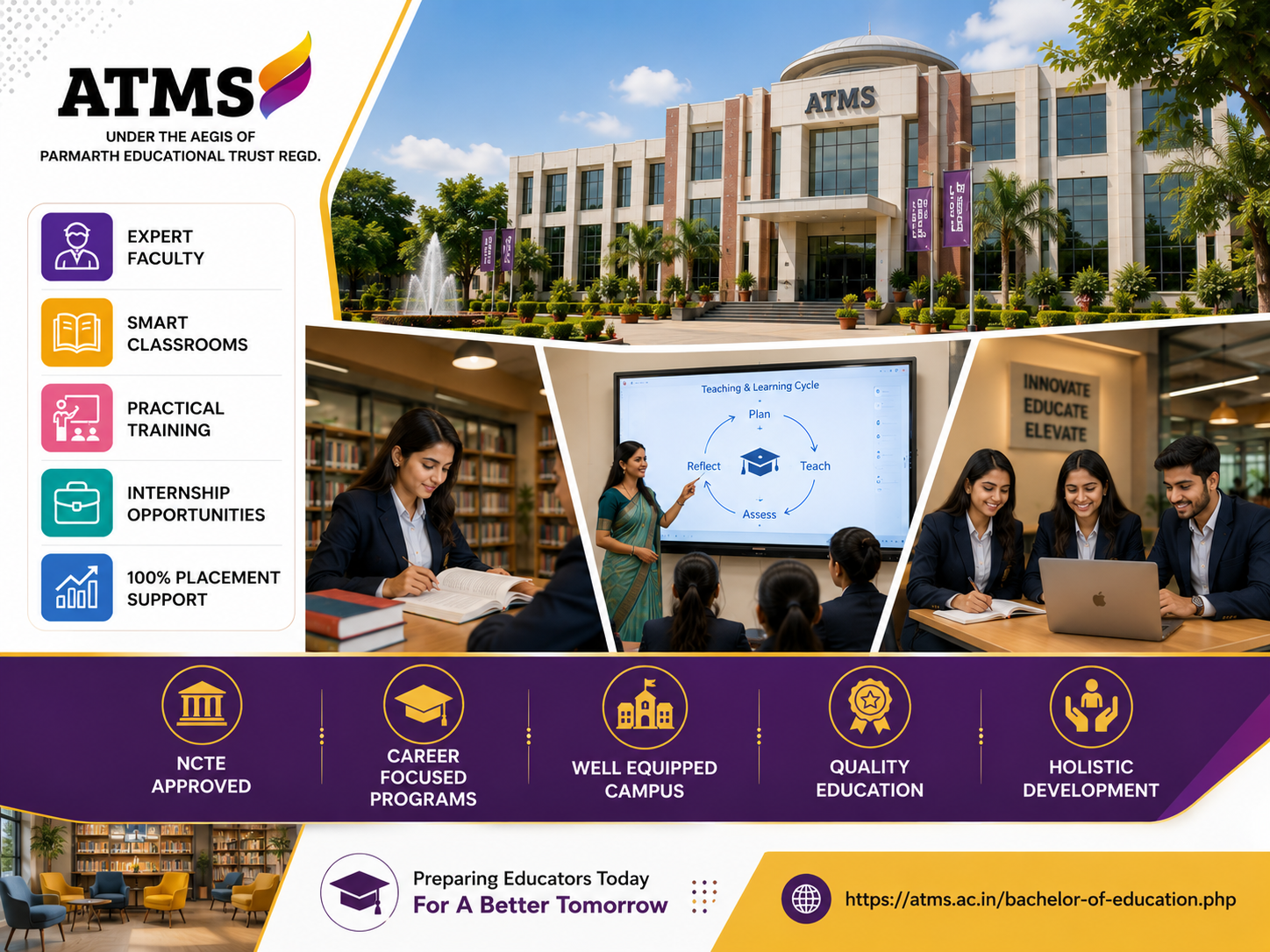
| Approvals & Affiliation | Affiliated with recognized universities; institutional approvals from AICTE and other statutory bodies listed on the official site |
| Faculty | Dedicated Department of Education with qualified faculty members |
| Practical Training | Structured teaching practice and classroom-oriented learning approach |
| Campus Facilities | Library, ICT infrastructure, seminar halls, and academic support spaces |
| Placement Support | Institutional placement assistance and career guidance cell |
| Location Advantage | Accessible from Meerut, Hapur, Ghaziabad, and NCR towns via NH-24 |
| Campus Life | Regular events, industry expert sessions, and value-added skill programs |
| Multi-Disciplinary Campus | Part of a larger institution offering B.Tech, BCA, BBA, BAJMC, and Pharmacy programs, enabling cross-disciplinary exposure |
Image Alt Text Suggestion: “B.Ed College near Noida NCR — ATMS Department of Education campus and classrooms”
The Role of Practical Training and Internships in Teacher Preparation
Theory can explain how a classroom should function. Only practice teaches you how to actually run one.
During a B.Ed program, students typically undergo supervised teaching practice in partner or affiliated schools. This includes:
- Observing experienced teachers conduct actual lessons
- Preparing and delivering lesson plans under faculty supervision
- Receiving structured feedback on classroom management and delivery
- Learning to handle real classroom dynamics — from student engagement to time management
This hands-on Classroom Training is often the single biggest confidence-builder for new teachers. Students who complete a robust internship component typically report feeling significantly more prepared for their first full-time teaching role compared to those trained through theory-heavy programs alone.
Modern Pedagogy and Digital Learning — Preparing Teachers for Tomorrow’s Classrooms
The classroom of 2026 looks nothing like the classroom of 2010. Smart boards, learning management systems, video-based content, and hybrid classrooms have become part of everyday school life across India — including in NCR-region schools near Meerut, Ghaziabad, and Hapur.
A future-ready teacher education program should therefore integrate:
- Digital literacy training — familiarity with classroom technology and presentation tools
- Blended learning methodology — combining in-person and digital instruction techniques
- Assessment technology — using digital tools for tracking student progress
- Communication tools — parent-teacher communication platforms increasingly used by modern schools
Institutions that build this exposure into their B.Ed curriculum are preparing Future Teachers not just to pass their final exams, but to walk into a real, tech-integrated classroom with confidence on day one.
The Most Underrated Factor in Teacher Education
Ask any successful teacher what shaped them the most during their training, and most will point not to a textbook, but to a specific faculty member or mentor.
Experienced faculty bring:
- Real classroom anecdotes that make theoretical concepts tangible
- Honest, constructive feedback during teaching practice
- Guidance on handling difficult classroom situations
- Insight into school recruitment processes and expectations
When evaluating any Teacher Training College, ask about faculty qualifications, years of classroom or academic experience, and their involvement in student mentorship — not just their academic degrees.
Campus Facilities and Learning Environment
A B.Ed student’s daily experience is shaped as much by their physical learning environment as by their coursework. Facilities worth evaluating include:
- Library resources — availability of pedagogy books, journals, and reference material
- ICT labs — access to computers, projectors, and digital teaching tools
- Seminar and workshop halls — spaces for guest lectures, panel discussions, and skill-building sessions
- Practice-teaching classrooms — dedicated spaces that simulate real school classrooms
- Common and recreational spaces — supporting overall student well-being during an academically demanding program
According to its official website, ATMS maintains dedicated academic and campus facility pages describing its library, labs, and infrastructure — details prospective students should review directly before applying.
Turning a Degree Into a Career
A B.Ed Admission decision is ultimately an investment in your future employability. That’s why placement and career guidance support matters as much as the classroom curriculum itself.
Strong placement support typically includes:
- Resume and portfolio-building workshops
- Mock interviews and communication skill sessions
- School and institutional tie-ups for recruitment drives
- Guidance for competitive teaching exams like CTET, UPTET, and state-level TETs
- Career counseling for further academic paths, such as M.Ed or specialized certifications
The ATMS website features a dedicated success-story and recruiters section, showcasing the institution’s broader placement ecosystem across its academic departments — an useful reference point for students evaluating placement support as part of their college shortlist.
Industry Exposure and Campus Events
Beyond the classroom, exposure to real educators, guest experts, and structured events adds meaningful value to a student’s overall development. Based on its official news and updates section, ATMS conducts periodic industry expert sessions, value-added skill programs, and on-campus events throughout the academic year — the kind of exposure that helps Future Teachers build soft skills, confidence, and professional awareness alongside their core coursework.
Career Opportunities After B.Ed
A B.Ed degree is far more versatile than many students realize. While classroom teaching remains the most common path, graduates today have access to a wide and growing range of roles across the education ecosystem.
Career Opportunities After B.Ed
| Career Path | Role Description |
| Primary/Secondary School Teacher | Teach core subjects in government or private schools after clearing CTET/TET exams |
| Special Educator | Support students with learning differences in inclusive classroom settings |
| Curriculum Designer | Develop lesson plans, academic content, and teaching resources |
| Educational Content Writer | Create textbooks, study guides, and structured digital learning material |
| School Counsellor | Guide students on academic choices and career pathways |
| Coaching Institute Educator | Teach at competitive exam coaching centers and tuition academies |
| Ed-Tech Instructor | Deliver structured lessons on online and hybrid learning platforms |
| Academic Coordinator | Support school administration in curriculum planning and teacher coordination |
| School Principal (with experience) | Progress into leadership and administrative roles over time |
| Education Researcher | Contribute to curriculum development and educational policy research |
Eligibility Criteria and Admission Process for B.Ed
While specific requirements can vary slightly by university, most B.Ed programs across India follow a similar structure:
General Eligibility
- A bachelor’s degree (B.A., B.Sc., B.Com, or equivalent) from a recognized university
- Minimum qualifying percentage as prescribed by the affiliating university (commonly around 50%, with relaxations for reserved categories as per applicable norms)
- Some universities may require candidates to clear a state-level or university entrance test
Step-by-Step Admission Process
- Check eligibility against the affiliating university’s prescribed criteria
- Shortlist colleges using the checklist covered earlier — approvals, faculty, facilities, and placement support
- Register and apply through the official college admission portal
- Submit required documents, including academic transcripts and identity proof
- Complete the counseling or entrance process, if applicable, as per university norms
- Confirm admission through fee payment and document verification
- Begin your Professional Teaching Course and start building the foundation of your teaching career
Prospective students interested in ATMS can review the official B.Ed admission procedure page on atms.ac.in for the most current, institution-specific process and requirements.
Why Location Matters — Meerut and the NCR Education Corridor
For students based in Meerut and surrounding districts, proximity to a well-connected campus can significantly influence day-to-day feasibility — particularly for those commuting daily or considering hostel arrangements. Institutions located along major connectivity routes such as NH-24 offer practical accessibility for students from Meerut, Ghaziabad, and other nearby NCR towns, without requiring relocation to a metro city.
This regional accessibility, combined with the academic fundamentals discussed throughout this article, is why many students researching the B.Ed College near Meerut and its neighboring belt look closely at institutions positioned within this NCR education corrid
A Quick Comparison Checklist Before You Apply
Use this simple checklist while comparing any shortlisted colleges, including ATMS:
- Is the college NCTE approved and university-affiliated?
- Does it offer structured teaching internships with partner schools?
- What is the faculty’s classroom or academic experience?
- Are digital learning tools integrated into the curriculum?
- What campus facilities are available — library, ICT labs, seminar halls?
- Does the college offer placement support and career guidance?
- Is the campus reasonably accessible from your home city or town?
- Does the college have a transparent, updated official website with verifiable information?
Applying this checklist consistently — to ATMS or any other institute — will help you make a confident, well-informed B.Ed Admission decision.
Frequently Asked Questions (FAQ)
1. What makes a college a B.Ed College near Meerut and the surrounding NCR belt? Look for NCTE approval, recognized university affiliation, experienced faculty, structured teaching internships, modern digital learning integration, and genuine placement support — not marketing claims alone.
2. Is a B.Ed degree mandatory to become a school teacher in India?
Yes. A B.Ed degree is a mandatory qualification for teaching at most primary and secondary levels in government and recognized private schools, alongside clearing the relevant TET or CTET exam.
3. What is the eligibility criteria for B.Ed admission?
Generally, candidates need a bachelor’s degree from a recognized university with the minimum qualifying marks prescribed by the affiliating institution; specific criteria can vary by university and category.
4. How long does a B.Ed program typically take to complete?
Most B.Ed programs in India are structured as two-year full-time courses, divided across four semesters that combine coursework, internal assessments, and teaching practice.
5. Does ATMS offer placement support for B.Ed students?
As per the official ATMS website, the institution provides placement assistance and career guidance across its academic departments, including its Department of Education.
6. What career options are available after completing a B.Ed?
Graduates can pursue roles as school teachers, special educators, curriculum designers, academic coordinators, ed-tech instructors, school counsellors, and educational content creators, among other paths.
7. What is the difference between B.Ed and D.El.Ed?
B.Ed is a degree-level program typically pursued after graduation and is required for secondary-level teaching, while D.El.Ed is a diploma-level program focused primarily on preparing candidates for primary-level teaching roles.
8. Is teaching practice or internship compulsory during B.Ed?
Yes. Supervised teaching practice in partner or affiliated schools is a mandatory and central component of any recognized B.Ed program, forming the practical foundation of teacher training.
9. Can I pursue a B.Ed after completing a B.Com or B.Sc degree?
Yes. A B.Ed program is open to graduates from any stream — Arts, Commerce, or Science — as long as they meet the minimum eligibility criteria set by the affiliating university.
10. What is CTET, and why does it matter after B.Ed?
CTET (Central Teacher Eligibility Test) is a national-level eligibility exam that, along with a B.Ed degree, qualifies candidates for teaching positions in central government and many state-affiliated schools.
11. How can I apply for B.Ed admission at ATMS?
Interested candidates can check eligibility and apply directly through the official ATMS admission portal linked on atms.ac.in, or contact the college’s admission office for guided assistance.
12. Are there entrance exams required for B.Ed admission?
Some universities require candidates to clear a state-level or university-specific entrance test before admission, while others admit based on qualifying degree marks; requirements vary by affiliating university.
Conclusion:
Teaching is one of the few professions where your training directly shapes the lives of the students you will one day guide. That responsibility deserves to begin at an institution built on proper approvals, experienced faculty, hands-on classroom training, and genuine placement support — not just an attractive prospectus.
If you are researching the B.Ed College near Meerut and the surrounding NCR education corridor, take the time to apply the checklist covered in this guide — affiliation, faculty experience, practical training, campus facilities, and placement support — to every institution on your shortlist. Based on the information available on its official website, ATMS Group of Institutions offers a Department of Education structured around these very fundamentals, positioned along the NH-24 corridor for accessibility from Meerut, Hapur, Ghaziabad, and nearby towns.
Ready to take the next step in your teaching career? Visit atms.ac.in to explore the B.Ed program in detail, review eligibility and admission procedures, download the official e-brochure, or apply directly through the ATMS admission portal.