
The media and communication industry has changed faster in the last decade than in the previous fifty years combined. News is consumed on phones before it appears on television, brands build entire campaigns around social media rather than print, and a single video can reach millions of people in hours. For students who want to build a career in this fast-moving world, choosing the BAJMC college in Delhi NCR is the first and most important decision they will make.
A Bachelor of Arts in Journalism and Mass Communication (BAJMC) is not just an academic degree — it is a launchpad into journalism, public relations, advertising, digital media, and content creation. But the industry doesn’t just want graduates who understand media theory; it wants people who can write a clean news report, shoot and edit a video, manage a social media campaign, and think critically under deadline pressure. That is exactly the kind of preparation a strong BAJMC course in Delhi NCR is meant to provide.
With the media landscape becoming more digital, more competitive, and more skill-driven every year, this article breaks down what a BAJMC program actually involves, what skills it builds, and how students in the Delhi NCR region — including Delhi, Noida, Greater Noida, Ghaziabad, Gurugram, Faridabad, and nearby areas such as Hapur — can evaluate colleges to make a genuinely informed choice.
Why Choose a BAJMC Course for a Media Career?
Journalism and mass communication is one of the few fields where classroom learning and real-world application are almost inseparable. A BAJMC course in Delhi NCR typically prepares students by combining media theory with hands-on production and reporting experience.
Here’s what the course is generally designed to build:
- News writing and reporting — the fundamentals of gathering facts, structuring a story, and writing for print, digital, radio, or television.
- Mass communication theory — understanding how media messages are created, distributed, and consumed by different audiences.
- Public relations and corporate communication — managing an organisation’s public image, media relations, and crisis communication.
- Advertising and campaign planning — developing creative concepts and media strategies for brands and products.
- Digital and social media skills — content creation, blogging, vlogging, and social media strategy for modern digital platforms.
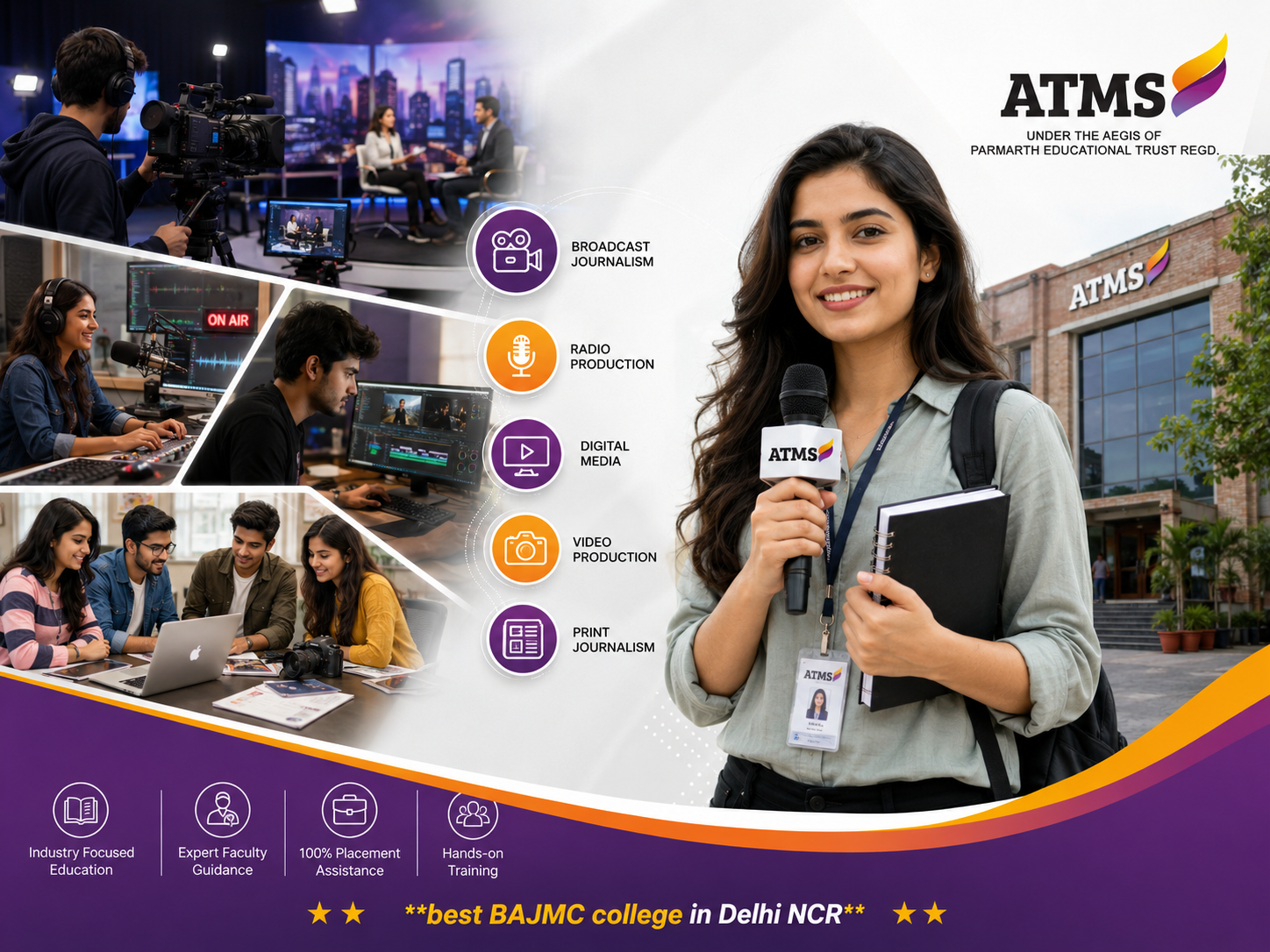
- Media production — practical training in photography, video production, radio broadcasting, and television production.
- Media law and ethics — understanding press freedom, defamation, and the ethical responsibilities of a media professional.
- Communication research — research methods used to study media effects and audience behaviour.
A genuinely strong BAJMC program treats media as a practical craft — something you learn by doing, not just by reading about it. This is why the quality of practical exposure matters as much as the theoretical syllabus.
What Makes a BAJMC College a Strong Choice?
Not every institute offering a BAJMC degree delivers the same quality of training. When comparing options for the BAJMC college in Delhi NCR, here is what genuinely separates a strong program from an average one:
| Evaluation Factor | Why It Matters |
| University Affiliation | A BAJMC program affiliated with a recognized university ensures the degree carries proper academic and professional value. |
| Qualified Faculty | Faculty with genuine media, journalism, or communication industry experience bring practical insight beyond textbooks. |
| Curriculum Depth | A curriculum covering journalism, PR, advertising, digital media, and production prepares well-rounded media professionals. |
| Media Production Facilities | Access to cameras, editing software, studios, and broadcasting equipment is essential for hands-on learning. |
| Internship Opportunities | Placements with media houses, PR firms, ad agencies, or digital platforms convert classroom learning into real industry exposure. |
| Live Projects & Field Visits | Practical assignments like campus radio shows, mock campaigns, or newsroom simulations build real confidence. |
| Industry Exposure | Workshops, guest lectures, and tie-ups with media professionals keep students updated with current industry practices. |
| Career Guidance | Support with portfolio building, interview preparation, and industry networking adds real value after graduation. |
| Location & Accessibility | A campus that is reasonably accessible across the Delhi NCR region makes commuting and internships more practical. |
| Transparent Admission Process | Clear, verifiable information about eligibility, fees, and affiliation builds trust before you apply. |
A college shouldn’t be judged as “the best” simply because it says so — it’s worth verifying university affiliation, checking the media facilities in person, and speaking with current students before making a decision.
Practical Exposure: Where Real Learning Happens
Media and communication is a field where confidence comes from doing, not just studying. A well-structured BAJMC program typically builds this practical exposure through:
- Internships — supervised placements with media houses, PR firms, advertising agencies, or digital platforms, where students apply classroom learning in real professional settings.
- Field visits — trips to newsrooms, production houses, or media organisations to understand how the industry actually functions on a day-to-day basis.
- Workshops and seminars — sessions on emerging communication tools, digital platforms, and production technologies, often led by faculty or visiting industry professionals.
- Live projects — creating radio shows, short documentaries, social media campaigns, or advertisement concepts as part of coursework, rather than only studying them in theory.
Internships and live projects are often what determine how quickly a fresh graduate can adapt to a real newsroom, PR agency, or digital content team. A program that only teaches media theory without this practical layer leaves students underprepared for the pace of the industry.
Skills Future Media Professionals Develop During BAJMC
A BAJMC course in Delhi NCR is designed to build a specific, industry-relevant skill set. Students typically develop:
- Writing and editing — crafting news stories, articles, scripts, and content across print, digital, radio, and television formats.
- Media production — creating and editing multimedia content such as videos, podcasts, and radio programs.
- Critical thinking — analysing media content, audience behaviour, and communication trends with a questioning mindset.
- Digital literacy — using digital tools for content creation, blogging, vlogging, and social media management effectively.
- Communication and presentation — strong verbal and written communication, public speaking, and on-camera presentation skills.
- Research skills — gathering, verifying, and analysing information before it is presented to an audience.
- Teamwork and deadline management — working collaboratively on productions and campaigns while meeting tight publishing schedules.
These are precisely the competencies media houses, PR agencies, and digital marketing teams look for when hiring — which is why the depth of practical training during a BAJMC program matters just as much as the degree itself.
BAJMC Curriculum Overview
A well-rounded BAJMC curriculum blends theoretical foundations with production-focused, practical subjects. Here’s a general overview of what the course typically covers:
| Course Area | What It Covers |
| Journalism | Principles of journalism, news writing, reporting, editing, and investigative journalism. |
| Mass Communication | Theories of mass communication, communication models, and the role of media in society. |
| Public Relations | Fundamentals of PR, media relations, crisis management, and corporate communication. |
| Advertising | Advertising principles, campaign planning, marketing communication, and media planning. |
| Digital Media | Digital journalism, online content creation, social media strategy, and multimedia production. |
| Media Ethics & Law | Ethical issues in journalism, media law, and press freedom. |
| Media Production | Practical training in photography, video production, radio broadcasting, and television production. |
| Communication Research | Research methods and techniques used in media and communication studies. |
This blend of theory and production-based learning is what allows BAJMC graduates to step into varied roles — from a newsroom to a PR agency to a digital content studio — rather than being limited to a single career path.
Career Opportunities After BAJMC
A BAJMC degree opens doors to a genuinely wide range of career paths across traditional and digital media. Common opportunities include:
- Journalist (Print, Digital, TV, or Radio)
- Content Writer or Editor
- Public Relations Executive
- Advertising Executive
- Social Media Manager
- Media Planner
- Broadcasting/Production Assistant
- Digital Content Creator
- Media Researcher
- Film or Documentary Production Assistant
The media industry today is far broader than traditional journalism — it now spans digital marketing, brand communication, podcasting, and content strategy, giving BAJMC graduates a wider range of career options than a decade ago. That said, specific roles may have their own hiring requirements, portfolios, or entry-level assessments depending on the organisation, so it helps to research target roles early.
How to Choose a BAJMC College in Delhi NCR
With multiple institutes now offering BAJMC programs across Delhi, Noida, Greater Noida, Ghaziabad, Gurugram, and Faridabad, here’s a practical checklist to guide your decision:
- Verify university affiliation — Confirm the affiliating university directly through official sources.
- Research faculty backgrounds — Look for educators with real journalism, PR, or media production experience.
- Review the curriculum — Ensure it covers journalism, PR, advertising, digital media, and production, not just theory.
- Check media production facilities — Studios, editing labs, and broadcasting equipment matter for practical learning.
- Ask about internship tie-ups — Structured placements with media houses or agencies add significant value.
- Look for live projects — Programs offering real campaigns, radio shows, or newsroom simulations build stronger portfolios.
- Understand the admission process — Confirm eligibility and application steps for the current academic year.
- Clarify fees and financial planning — Get the current, official fee structure directly from the institution.
- Read genuine student feedback — First-hand experiences from current students or alumni add real perspective.
- Consider location and accessibility — Since BAJMC involves internships and field visits, a reasonably commutable campus is a practical advantage.
A strong BAJMC program is ultimately judged by how much real production and reporting experience it gives students before they graduate — not by claims alone.
Building a Career-Ready Media Portfolio
Unlike many academic degrees, media careers are heavily portfolio-driven. Employers in journalism, PR, and digital media routinely ask to see actual work — published articles, video edits, campaign concepts, or social media projects — before considering a candidate.
This is why a good BAJMC program in Delhi NCR should actively help students build a portfolio through:
- Regular writing and editing assignments across formats
- Supervised production projects (video, radio, or digital content)
- Internship work that can be included in a professional portfolio
- Guidance on presenting work professionally for job applications
Students who graduate with a strong, varied portfolio — not just a degree certificate — tend to have a real head start when applying for entry-level media and communication roles.
Frequently Asked Questions
1. What is a BAJMC course?
BAJMC stands for Bachelor of Arts in Journalism and Mass Communication — a three-year undergraduate program that trains students in journalism, media production, advertising, public relations, and digital communication.
2. Who is eligible for a BAJMC program?
Eligibility generally requires 10+2 or an equivalent qualification. Candidates awaiting their results are often eligible to apply, subject to clearing the qualifying exam. Always confirm the current criteria with the specific institution.
3. How long does a BAJMC course usually take?
Most BAJMC programs are structured as a three-year undergraduate course, though the exact structure can vary depending on the affiliating university.
4. What should students look for in a BAJMC college in Delhi NCR?
Look for recognized university affiliation, experienced faculty, strong media production facilities, structured internship opportunities, and transparent admission information.
5. How can I choose a BAJMC college in Delhi NCR?
Compare institutions based on curriculum depth, practical training and production facilities, internship tie-ups, and genuine student feedback — rather than promotional claims alone.
6. Is practical training important during BAJMC?
Yes. Internships, live projects, and field visits are often the most valuable part of the program, helping students build real industry-ready skills and a professional portfolio.
7. What career options are available after completing BAJMC?
Graduates can pursue roles such as journalist, content writer, PR executive, advertising executive, social media manager, and digital content creator, among others.
8. Is internship part of a BAJMC program?
Yes, most BAJMC programs include internships with media houses, PR firms, advertising agencies, or digital platforms as a core component of practical training.
9. What skills can students develop through a BAJMC program?
Key skills include news writing, media production, critical thinking, digital literacy, research, communication, and presentation abilities.
10. What documents are generally required for BAJMC admission?
This typically includes 10+2 mark sheets, identity proof, and other standard admission documents — exact requirements should always be confirmed with the specific institution’s current admission notification.
Making an Informed Decision
Choosing where to pursue your BAJMC in Delhi NCR shapes the foundation of your entire media career. Instead of relying on marketing claims, take the time to:
- Explore the BAJMC curriculum and production facilities in detail.
- Review eligibility and admission information directly from official sources.
- Visit the campus or explore the official website to understand infrastructure first-hand.
- Ask about internship and industry tie-ups to understand real practical exposure.
- Speak with current students or alumni, if possible, for a genuine sense of the learning environment.
A well-researched choice today lays the foundation for a confident, capable, and career-ready future in journalism, public relations, advertising, or digital media.