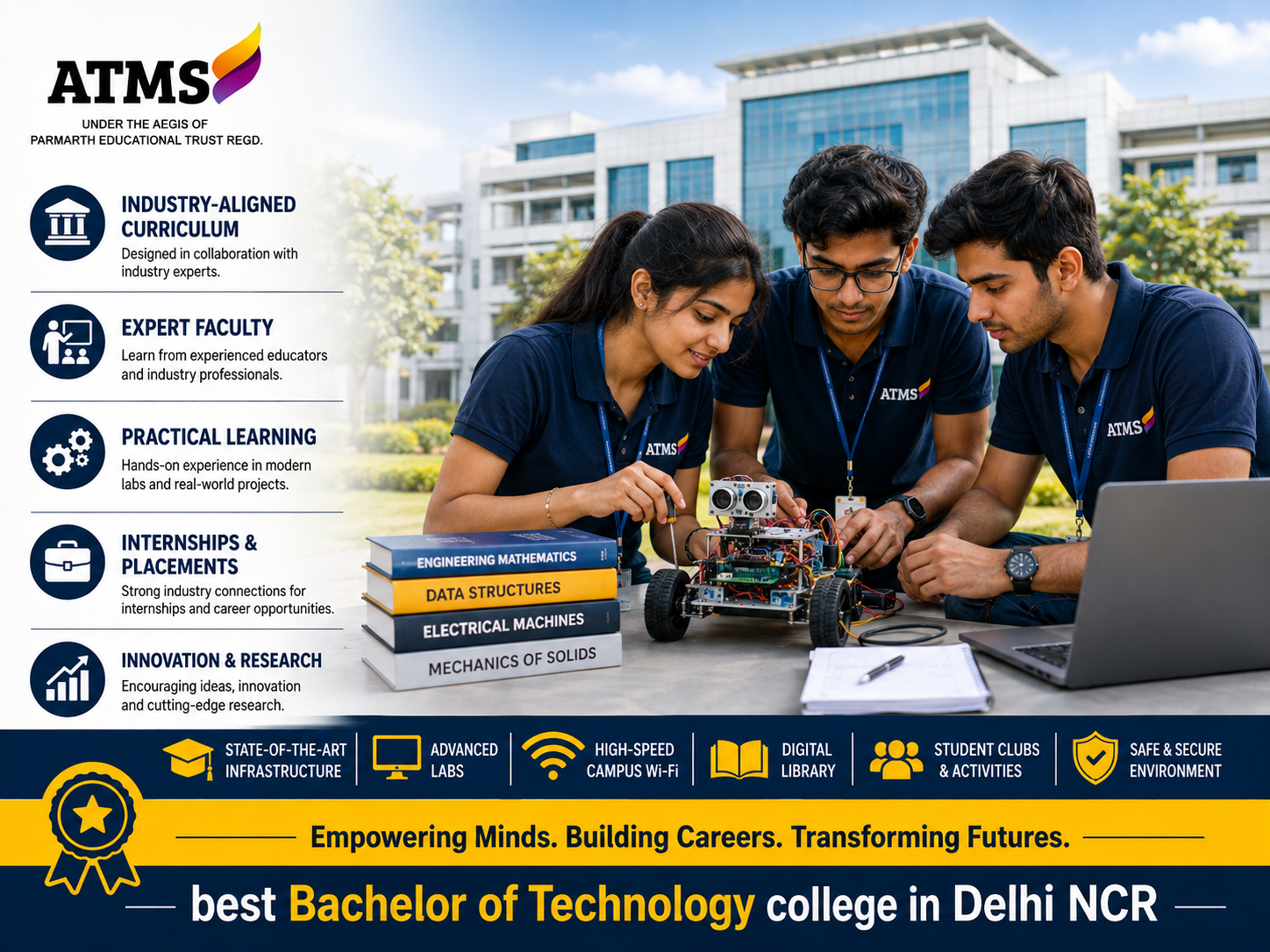

Engineering education is undergoing a quiet but significant transformation. The traditional model — heavy on theory, light on application — is gradually giving way to a more integrated approach that blends classroom learning with hands-on, real-world problem-solving. Employers today expect graduates who can not only explain a concept but also apply it, adapt it, and build something useful from it.
This shift makes industry-focused learning one of the most important factors for students to consider when evaluating an engineering program. A degree alone is no longer a sufficient marker of readiness; what matters increasingly is exposure to live projects, modern tools, and professional environments during the course of study.
For students researching the best Bachelor of Technology college in Delhi NCR, this means looking well beyond brochures and rankings. It means examining curriculum design, laboratory infrastructure, internship pipelines, and the extent to which an institution connects academic learning to the realities of engineering practice. This article walks through what genuinely strong B.Tech education looks like, the specializations available to aspiring engineers, and a practical framework for comparing institutions in the Delhi NCR region.
Why Industry-Focused Learning Matters in Engineering
Engineering, at its core, is a discipline of applied problem-solving. Concepts learned in a classroom — thermodynamics, data structures, circuit theory — only become useful when a student can translate them into working solutions. This is where industry-focused learning plays its role.
Practical learning helps students internalize concepts far more effectively than memorization alone. When a student builds a circuit, debugs code, or designs a small mechanical component, the underlying theory becomes tangible rather than abstract.
Project-based education pushes students to work across multiple concepts simultaneously, much like real engineering assignments require. A single project might demand knowledge of programming, data analysis, and design thinking all at once.
Laboratory experience is equally essential. Labs allow students to test theoretical models, observe outcomes, and understand the gap between ideal conditions and real-world variables — a gap every practicing engineer eventually has to manage.
Beyond technical execution, this style of learning nurtures problem-solving skills, exposes students to current technology, and encourages innovation and creativity by rewarding original thinking rather than rote answers. Regular industry interaction — through mentors, guest experts, or collaborative assignments — further helps students understand how engineering knowledge is applied within actual organizations.
What Makes a Strong B.Tech Education?
Not all engineering programs are structured the same way, and the differences often show up in outcomes years later. When evaluating a program, students should look closely at the following factors:
- Experienced and qualified faculty who can guide both academic understanding and practical application
- An updated curriculum that reflects current industry practices and technologies
- Access to practical laboratories with functioning, relevant equipment
- Modern infrastructure that supports both classroom and project-based learning
- Active technical clubs where students can pursue interests beyond the syllabus
- Structured coding and technology exposure, particularly for computing-related branches
- Regular workshops and seminars conducted by faculty or visiting professionals
- Genuine internship opportunities connected to the student’s field of study
- Consistent industry interaction through collaborations, visits, or joint projects
- Access to career guidance and academic mentorship
- Structured placement preparation, including communication and interview readiness
- Opportunities for research and innovation, even at the undergraduate level
Students are encouraged to verify each of these points directly with the institution they are considering, since the presence and quality of these elements vary significantly across colleges.
Popular B.Tech Specializations for Future Engineers
Engineering is a broad discipline, and choosing the right specialization is one of the most consequential decisions a student will make. The table below outlines commonly offered branches and what they typically involve.
| B.Tech Specialization | What Students Learn | Potential Career Areas |
| Computer Science & Engineering | Programming, algorithms, databases, software development | Software, IT, technology |
| Artificial Intelligence & Machine Learning | AI models, machine learning, data-driven systems | AI, ML, automation |
| Information Technology | Software systems, networking, databases | IT services, software |
| Electronics & Communication Engineering | Electronics, communication systems, embedded technology | Electronics, telecom, embedded systems |
| Mechanical Engineering | Design, manufacturing, thermodynamics | Manufacturing, automotive, design |
| Civil Engineering | Construction, structures, infrastructure | Construction, infrastructure, engineering |
| Electrical Engineering | Power systems, electrical machines, control | Energy, electrical systems, automation |
Students should confirm the exact specializations, course structure, and elective options offered by any specific institution, as these details vary by college and academic year.
Practical Learning: Turning Theory into Engineering Skills
Practical exposure is what transforms theoretical knowledge into applicable skill. Institutions that prioritize industry-focused learning typically build this into the curriculum through several formats:
- Laboratory sessions that reinforce classroom concepts through direct experimentation
- Live projects based on real or simulated industry problems
- Industry-based assignments that mirror actual workplace tasks
- Workshops focused on specific tools, technologies, or techniques
- Simulations that allow students to model complex systems safely
- Design challenges that test creativity under practical constraints
- Hackathons that build speed, teamwork, and applied problem-solving
- Technical competitions that benchmark skills against peers
- Capstone projects, often completed in the final year, that consolidate learning into one substantial body of work
This kind of learning matters because engineering problems in the real world rarely arrive as clean, textbook exercises. Students who have practiced applying concepts under realistic constraints are generally better prepared to handle ambiguity, troubleshoot issues, and collaborate effectively once they enter the workforce.
Developing Industry-Ready Engineering Skills
Engineering students need a balanced combination of technical knowledge, problem-solving ability, communication, teamwork, adaptability, and professional skills. Practical projects, presentations, teamwork, and technology-based learning can help students become better prepared for professional environments.
Importance of Internships and Industry Exposure
Internships and industry exposure help students connect classroom knowledge with real-world applications. Industrial visits, expert sessions, workshops, live projects, and industry mentorship can provide valuable practical experience and a better understanding of workplace expectations. Students should also compare the internship support and industry opportunities offered by different institutions before choosing a B.Tech program.
How to Choose the Right Engineering College in Delhi NCR
With numerous institutions to choose from, evaluating options systematically can help students avoid decisions based purely on marketing claims. Consider the following steps when searching for the best Bachelor of Technology college in Delhi NCR:
- Check institutional approvals and affiliations with relevant regulatory and university bodies.
- Review the curriculum and specialization options to ensure they align with your interests.
- Evaluate faculty expertise, including academic qualifications and industry experience.
- Examine laboratories and learning infrastructure firsthand, if possible.
- Research internship opportunities and the institution’s industry connections.
- Review placement processes and any publicly available placement information, verifying it through official sources.
- Explore industry collaborations, including partnerships with companies or research bodies.
- Check student development activities such as clubs, competitions, and extracurricular programs.
- Compare total fees and available scholarships across shortlisted colleges.
- Visit the campus or attend an official counselling or admission session before finalizing a decision.
Following a structured comparison process, rather than relying on a single factor like reputation or advertising, generally leads to a more informed choice — one suited to a student’s specific goals and interests within engineering education.
Career Opportunities After B.Tech
A Bachelor of Technology degree opens the door to a wide range of career paths, depending on specialization and individual interest. Common directions include:
- Software Engineer
- Data Analyst
- AI/ML Engineer
- Electronics Engineer
- Mechanical Engineer
- Civil Engineer
- Electrical Engineer
- Design Engineer
- System Engineer
- Project Engineer
- Research and Development roles
- Higher education and postgraduate studies
- Entrepreneurship
Career outcomes depend on multiple factors, including specialization, skill development, internship experience, and individual effort. Students should treat any specific employment or salary claims with caution and verify them independently rather than assuming guaranteed outcomes.
Role of Faculty, Mentorship and Student Development
Experienced faculty and effective mentorship can greatly improve a student’s engineering journey. Faculty members support students through academic guidance, project supervision, career planning, technical development, research, and communication skills. Good mentorship also helps students understand industry expectations and make informed career decisions.
How Technology Is Transforming Engineering Education
Technology is making engineering education more practical, interactive, and industry-oriented. Tools such as AI, cloud computing, data analytics, simulation software, IoT, automation, digital learning platforms, and virtual laboratories help students gain exposure to modern technologies. Since engineering trends continue to change, students should also develop continuous learning and adaptability to stay prepared for future career opportunities.
A Student-Centric Approach to Engineering Education
Institutions that place students at the center of their approach typically support learning through several dimensions:
- Academic mentoring tailored to individual progress and challenges
- Career counselling that helps students make informed decisions about specialization and future paths
- Technical communities, such as clubs and interest groups, that extend learning beyond the classroom
- Innovation activities, including hackathons, ideation challenges, and design competitions
- Entrepreneurship support for students interested in building their own ventures
- Personality development programs that build confidence and interpersonal skills
- Communication training, particularly valuable for technical presentations and interviews
- Industry interaction, reinforcing the connection between coursework and professional practice
Since the extent of these offerings varies across institutions, students are encouraged to ask direct questions and, where possible, speak with current students or alumni for a realistic picture.
B.Tech Admission: What Students Should Consider
The admission process for B.Tech programs generally follows a structured path, though specific requirements vary by institution, university, and academic year. Broadly, students should be aware of:
- Eligibility criteria, which typically include minimum academic qualifications
- Entrance examination requirements, where applicable, based on national, state, or institutional-level tests
- Merit-based admission, in cases where entrance exams are not the sole criterion
- Counselling processes for seat allocation and specialization selection
- Required documents, usually including academic records and identification proof
- Fee considerations, including tuition and other institutional charges
- Scholarships, which may be available based on merit, need, or category
- Important deadlines for application, counselling, and admission confirmation
Because these details change frequently and differ by institution, students should always confirm current admission requirements directly through official sources before applying.
Why Delhi NCR Is a Strong Region for Engineering Aspirants
Delhi NCR offers a distinct advantage to engineering students due to its scale and diversity as a professional hub. Relevant factors include:
- A large technology and business ecosystem, encompassing IT, manufacturing, consulting, and more
- Proximity to companies that can provide meaningful industry exposure
- A relatively high concentration of internship opportunities across sectors
- Diversity across engineering sectors, from software to infrastructure
- Opportunities for professional networking through events, meetups, and industry forums
- An active startup ecosystem, useful for students interested in entrepreneurship
- Access to corporate and technology hubs spread across the region
While these regional advantages are genuine, they do not replace the need for due diligence at the institutional level. A strong regional ecosystem complements, but does not substitute for, a well-structured academic program.
Conclusion
Engineering education is no longer just about completing a syllabus — it is about building the practical judgment, technical depth, and adaptability that real-world engineering demands. As this article has outlined, factors like industry-focused learning, qualified faculty, updated curricula, functioning laboratories, and genuine internship pathways matter far more in the long run than any single ranking or promotional claim.
For students evaluating the best Bachelor of Technology college in Delhi NCR, the smartest approach is a structured one: compare specializations against personal interest, verify placement and infrastructure claims through official sources, and weigh the strength of an institution’s industry connections alongside its academic reputation. Delhi NCR’s dense technology and business ecosystem adds real value here, but it works best when paired with a program that is genuinely designed around practical engineering education and career-oriented education.
Ultimately, the right college is the one that helps a student move from theoretical understanding to applied competence — producing future-ready engineers who are prepared not just to graduate, but to contribute meaningfully from day one of their careers.
Frequently Asked Questions About B.Tech Education
1. What should students look for when choosing a B.Tech college in Delhi NCR?
Students should evaluate curriculum quality, faculty experience, laboratory infrastructure, internship support, and industry collaborations. It also helps to review admission requirements and verify placement information through official sources rather than relying solely on promotional material.
2. Which B.Tech specialization is suitable for a career in technology?
Computer Science & Engineering, Information Technology, and Artificial Intelligence & Machine Learning are commonly chosen for technology-focused careers. The right choice depends on individual interest, aptitude, and long-term career goals within the broader technology sector.
3. Why is practical learning important in engineering?
Practical learning helps students apply theoretical concepts to real situations, building problem-solving ability and technical confidence. It also prepares students for the kind of ambiguous, hands-on challenges they are likely to encounter in professional engineering roles.
4. How do internships benefit B.Tech students?
Internships expose students to real work environments, professional expectations, and practical applications of their coursework. They also help students build industry connections and gain clarity about potential career directions before graduation.
5. What skills should engineering students develop alongside academics?
Beyond technical knowledge, students benefit from developing communication, teamwork, project management, and adaptability. These skills are frequently emphasized by employers and play a significant role in long-term career growth.
6. How can students evaluate engineering college placements?
Students should ask for verified, official placement data rather than relying on informal claims. It also helps to speak with alumni, review the range of recruiting companies, and understand the placement support process offered by the institution.
7. Is industry exposure important during a B.Tech program?
Yes, industry exposure through internships, guest lectures, and live projects helps bridge the gap between academic learning and workplace expectations. It gives students a clearer sense of how their coursework applies in real professional settings.
8. What is the role of laboratories in engineering education?
Laboratories allow students to test theoretical concepts through hands-on experimentation, building both understanding and practical skill. They are especially important for disciplines that rely on tangible, applied outcomes.
9. How should students compare B.Tech colleges?
A structured comparison covering curriculum, faculty, infrastructure, internships, and verified placement information tends to be more reliable than relying on rankings or advertising alone. Campus visits and conversations with current students can add valuable context.
10. What career options are available after completing B.Tech?
Graduates can pursue roles such as software engineer, design engineer, or research and development specialist, depending on their specialization. Many also choose to pursue postgraduate studies or entrepreneurship as alternative paths after graduation.